
A short guide from a Florida IT team here since 1996
Do you have the keys to your own IT? Or does someone else?
Most owners think they know, until the one person who does is out on a Friday afternoon. Seven pages for owners who are done being the backup plan: the four questions you have been carrying, why it keeps happening, what it looks like when it is no longer on you, and one question to ask this week.
- 4questions you have been carrying, with honest answers
- 1question to ask whoever holds your keys this week
- 30minutes with a real person, no slides, no pitch
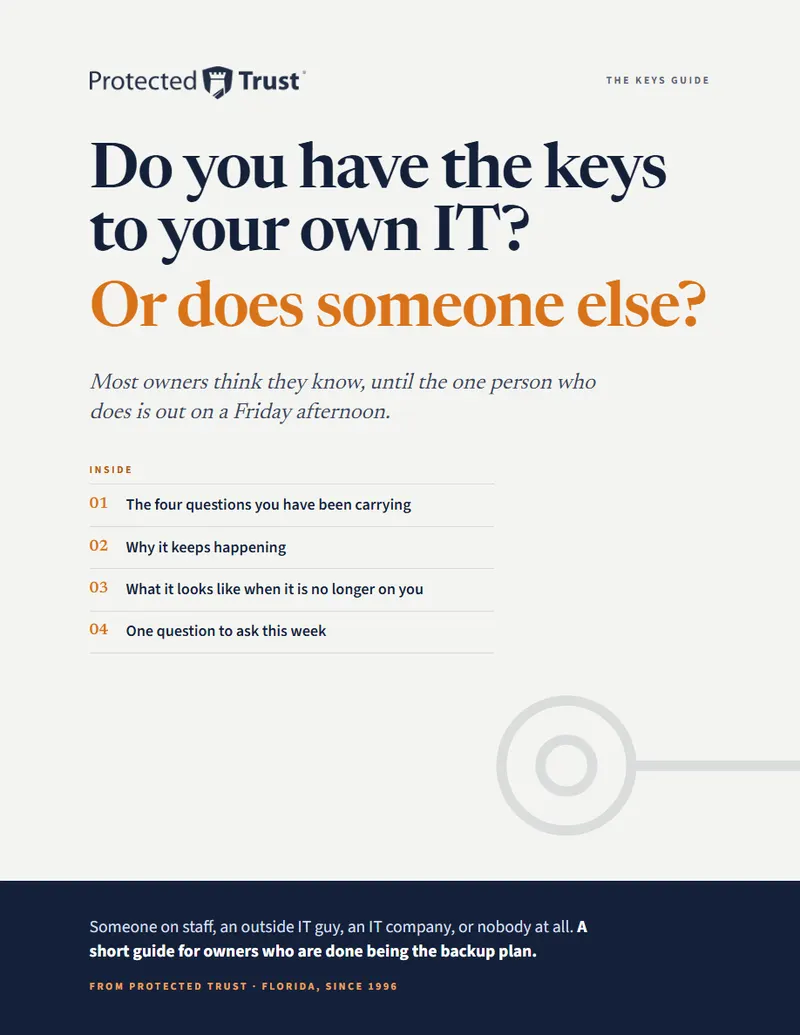
PDF, seven pages. Read it on your own, hand it to your IT provider, or bring it to a call with us.
If this sounds familiar
What goes through your head when it all runs through one person
"What happens the next time they're on vacation, out sick, or unreachable on a Friday afternoon?"
What is true
Nothing good, if everything runs through them. With a team, several people know you, and someone is watching around the clock.
"If something breaks this weekend, who do I actually call?"
What is true
You should never have to wonder. One number, a person who already knows your setup, and the problem is theirs until it is finished.
"How much of this business quietly depends on what's in one person's head?"
What is true
More than you think, and less than it has to. Written down and set up to one standard, it belongs to the business.
"What else is tied to their personal email, their phone, or their credit card that I don't know about?"
What is true
Usually a few things. Finding them is part of the handover, and you hold a copy of the keys from then on.
A note from Ingram

We have been running technology for Florida businesses since 1996. When I started Protected Trust in 2001, I built it around a few ideas borrowed from hospitality: treat people the way you would want to be treated, and know them by name.
That means nobody should have to figure out who to call, and nobody should have to explain themselves twice. It also means no business should depend on what one person happens to remember. You should always hold a copy of your own keys.
If this guide sounds like you, let's talk. You do not have to know what to do. That is our job.
Ingram Leedy, Founder and CEO, Protected Trust
Questions people ask
Plain answers.
What is in the guide?
Seven pages: the four questions owners carry when IT runs through one person, the cost of staying the backup plan, why one person is a single point of failure and what a team changes, what you want in our words, the fair worries about switching with plain answers, and a note from Ingram. No checklists and no technical detail. You do not need to become the expert.
Who is it for?
The owner whose IT depends on someone on staff, an outside IT person, an IT company, or nobody at all, and who would rather not be the backup plan. No technical knowledge is needed.
What happens after I ask for it?
It opens on the next page, and we email you the link so you can find it later. A real person may reach out once, by name, to offer thirty minutes. Nobody adds you to a list.
Is this a sales pitch?
It is a guide, and the only ask in it is thirty minutes if you want them. If we are not the right fit, we say so and point you to someone who can help.